Guide · Agency growth
How to find clients for a web design agency
Nobody is going to search for you. The work goes to whoever picks a territory, counts the gap in it, and calls the same list every week.
A territory methodA week-by-week rhythmUnglamorous on purpose
Pick a territory before you pick a tactic
Almost every struggling agency has the same problem. It sells to everyone, everywhere, and so it is known by nobody.
A territory is a trade plus a place. Dentists in Trondheim. Painters in Aarhus. Driving schools across one Swedish county.
Narrow feels wrong and works. Here is what it buys you.
- You can name the whole market. Forty firms is a list, not a market segment.
- Your examples land, because the last three sites you built were for their neighbours.
- Referral compounds. In a trade, everyone knows everyone, and they talk.
- Your pitch gets sharper each week, because the objections repeat.
- You can price with confidence, because you have quoted this job before.
Pick the territory on three tests. Can they pay? Do they lack a site? Does the work repeat?
Look for a trade with money and no web habit. In our file, 47% of Norwegian dentists have no website at all. That is a trade with real revenue, real competition, and half of it invisible on search.
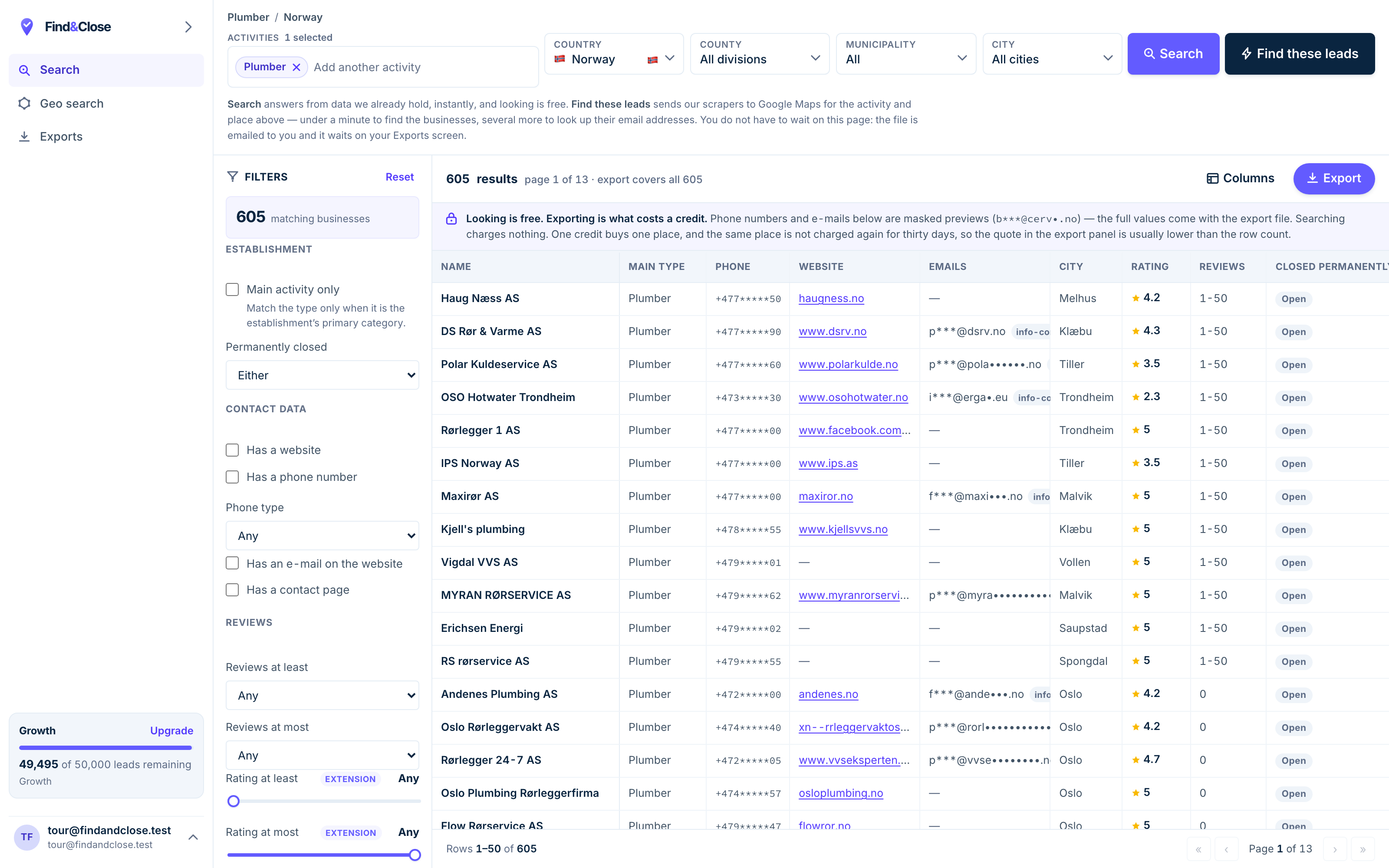
- Pick the trade Type it and take the match. One trade or twenty, on every plan.
- Pick the place Country, county, municipality, city. No plan gates the geography.
- The count moves first The number updates before you spend anything. Looking is free.
- Filter to the ones worth calling Has email, has phone, has a website, has a contact page. Combine them freely.
- Contacts are masked until export You can see a row exists and judge it. The address itself is the product.
- Export what you are looking at The file is exactly this filter set, with nothing dropped in between.
The no-website filter is the whole shortcut
One field turns a list of every business into a list of people with a problem you can name.
A firm with a website has an incumbent. Somebody built that site, and your pitch has to unseat them before it can sell anything.
A firm with no website has nobody. You are the first conversation, not the fourth quote.
The size of that group in the trades we publish, counted on 26 July 2026:
- Norway: 30% of 9,632 records have no website.
- Denmark: 28% of 3,927 records.
- Finland: 24% of 3,883 records.
- Sweden: 19% of 6,404 records.
Norway is the richest hunting ground in the set, which surprises everyone who assumes wealth means web presence. It does not. Referral trades drift off the web wherever they are.
The full method for finding these firms covers four ways to do it, including a free one.
Price a small local site
We will not put a price on your work. We will tell you which questions set it.
Three things move the number, and only three.
- Scope. One page or five. A form or a booking system. Photos you take or photos they send.
- Speed. A week costs more than a month. Small firms pay for speed because they hate the project hanging over them.
- What happens after. Hosting, edits, a listing you keep tidy. This is the part that turns a project into income.
Two things worth doing
Publish the price. A small firm stalls because it fears the number, not because it doubts the value. A page with a price on it removes the reason to delay.
Sell the recurring piece from the first conversation. One site is a payday. Twelve months of hosting and edits is a business.
A local owner who trusts you does not want a second vendor. Take the domain, the mailbox, the listing and the photos, and the retainer writes itself.
Two things worth avoiding
Do not quote hourly. It invites a conversation about your speed instead of their result.
Do not discount to close a first client. The price you take is the price that trade will hear about by Friday.
How many prospects a solo agency needs
Do not use anyone else’s benchmark. Work backwards from numbers you can check yourself.
The sum has four terms, and you already know two of them.
- Start with the money. How much do you want a month, and what does one client pay you? That gives you clients per month.
- Add your close rate. How many real conversations turn into work? Count last quarter rather than guessing.
- Add your contact rate. How many prospects turn into a real conversation? This is the term people skip.
- Multiply back up. Clients, divided by close rate, divided by contact rate. That is your prospect count per month.
Run it once and the answer is usually uncomfortable. Most solo agencies are working a list a tenth the size they need.
Now check it against the territory. If your trade holds forty firms in your town, the sum tells you whether that is a quarter of work or a year of it.
This is the real reason to size the segment before you start. A territory too small to feed the sum is not a territory. Widen the trade, widen the map, or accept a longer cycle.
The four countries we cover hold 44,684 records between them. Most agencies never work through the first town.
One week of prospecting
A rhythm you can keep while you deliver. It is dull, and dull is what survives a busy month.
- Monday morning: pull the list. One trade, one area, no website. Thirty to fifty rows is a week. Two hundred is a way to feel busy.
- Monday afternoon: check every row. Open the listing. Reviews, hours, a social page, a name if you can find one. Kill the dead rows now.
- Tuesday: write one email, not ten. One offer for one trade. Send it to the whole week’s list in small batches.
- Wednesday morning: call the top twenty. Before eight or after four. Ask where their work comes from. Take notes on the row.
- Thursday: send the proof. Two examples from the same trade, with the price on the page. Reply to anyone who answered, same day.
- Friday morning: the breakup email. To everyone silent from last week’s list. Two lines. Then close their file and mean it.
- Friday afternoon: count. Rows worked, conversations had, quotes out, work won. Four numbers in one sheet, every week.
That is roughly a day of work spread across five, and it runs alongside delivery. The point is not intensity. It is that the list never stops moving.
The cold email guide has the full sequence, including the breakup message that Friday depends on.
What to say when they answer
Most agency pitches fail because they sell the craft. Local owners do not buy craft.
They buy three things: more calls, less admin, and looking like a real firm next to the one down the road.
So the first conversation has one job. Find out where their work comes from today, and what happens when that source dries up.
- If they say word of mouth, ask what happens in a slow quarter.
- If they name a platform, ask what it costs them per booking.
- If they say Facebook, ask what a customer sees when they search the trade.
- If they say they are too busy, ask who they turn away and why.
Every one of those questions ends in the same place, and none of them is a pitch.
Then show one example from their trade, name a price, and offer a start date. A start date is the close. It always was.
Questions from agency owners
Is cold outreach still worth it for a web agency?
In local, yes, because almost nobody does it well. Referral and ads both cap out, and neither one lets you choose your market.
Cold outreach is the only channel where you pick the trade, the town and the size of firm you want to work with.
Should I niche by trade or by town?
By trade first, then widen the map. A trade shares vocabulary, objections and referral networks, and none of that travels across trades.
Once the pitch works for dentists in one city, it works for dentists in the next one. The same is not true across trades in the same street.
What if the trade I want has no email addresses?
Then it is a phone territory, and you plan for that from the start. Only 3% of Danish painters have an email on their listing.
That is not a broken list. It is a trade nobody can email, which means a trade your competitors are not reaching either.
How do I compete with cheap website builders?
You do not compete on the build. Your buyer does not want a tool, they want the job done and gone.
Sell the whole outcome: the listing, the photos, the copy, the hosting, the edits. A builder sells software. You sell an afternoon they never have to think about.
How big should my first list be?
Small enough to finish in a week. Thirty to fifty rows you truly work beats a thousand you skim.
A worked list produces conversations. An unworked list produces the feeling of having a list.
Which trades are best to start with?
Look for money, a visible gap, and repeat work. In our file, Norwegian dentists and Norwegian accountants both run high on missing websites.
Norwegian law firms average 3.99 stars, the lowest of any trade we hold, and only 53% have claimed their listing. Reputation work sells itself there.
Read next
The list, the message, and the rules that sit around both.
- Find businesses with no website Four methods, honest trade-offs
- Build a local business email list Where the addresses really live
- Cold email local businesses Subject lines, length, a full sequence
- GDPR and B2B cold email Legitimate interest, opt-out, suppression
- Scrape Google Maps without code What Maps exposes, and what it hides
- Every list we publish Trades and countries
- Plumbers in Norway Phone and email flags per row
- Accountants in Norway A trade that drifts off the web
- Electricians in Norway Strong email coverage for a trade
- Electricians in Sweden The Swedish side of the same trade
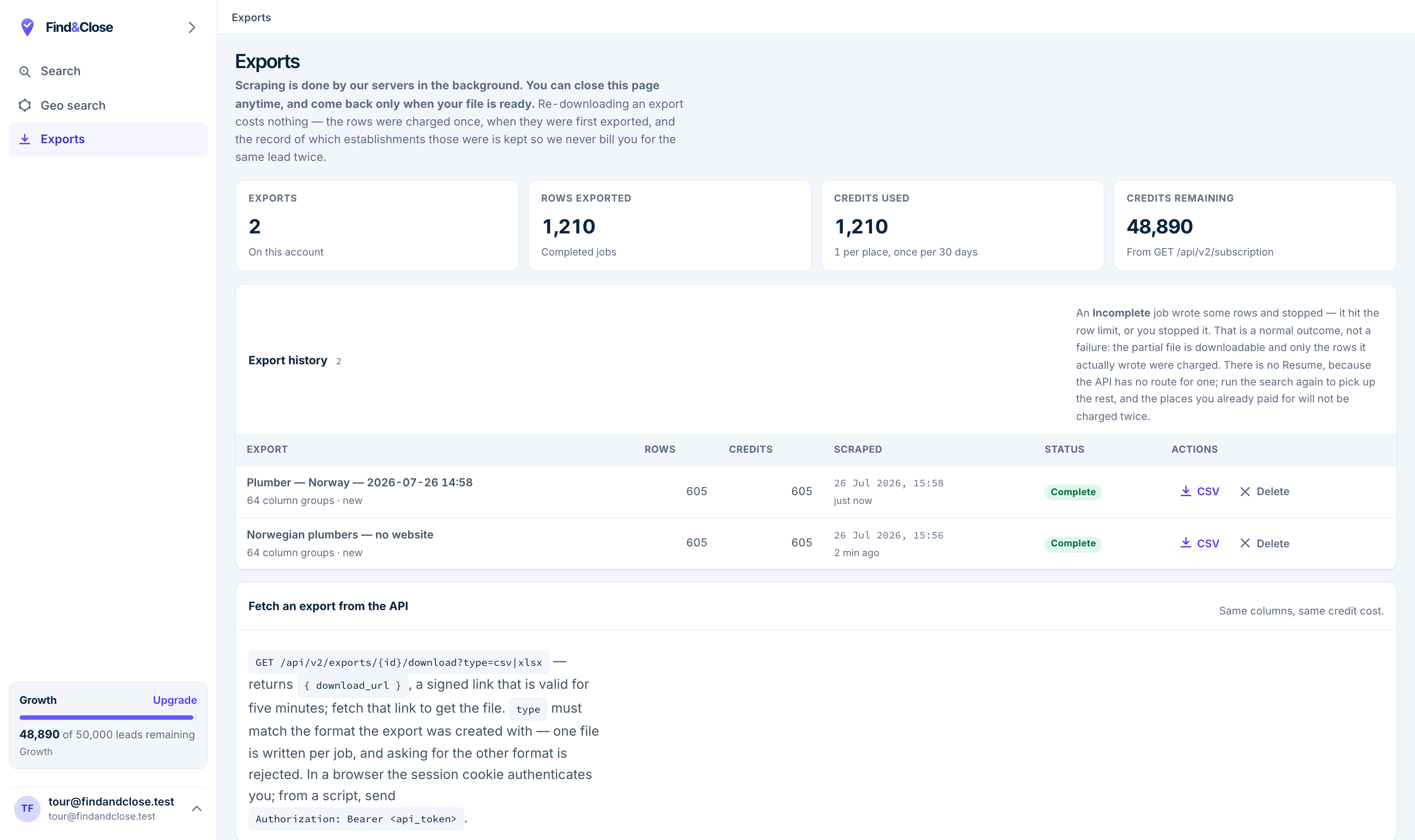
- Credits are counted, not guessed Charged once per place per 30 days, and refunded if a job stops early.
- Every job keeps its filter set The name and the column count travel with the file, so you can tell two exports apart.
- It runs without you Close the page. The file is here when it is done and we email you.
- Or fetch it from the API Same columns, same credit cost, one signed link.
Pick your territory and count the gap
Fourteen days, 100 leads, no card. Enough to size one trade in one region before you commit a quarter to it.
- 14-day free trial
- 100 leads included
- No credit card